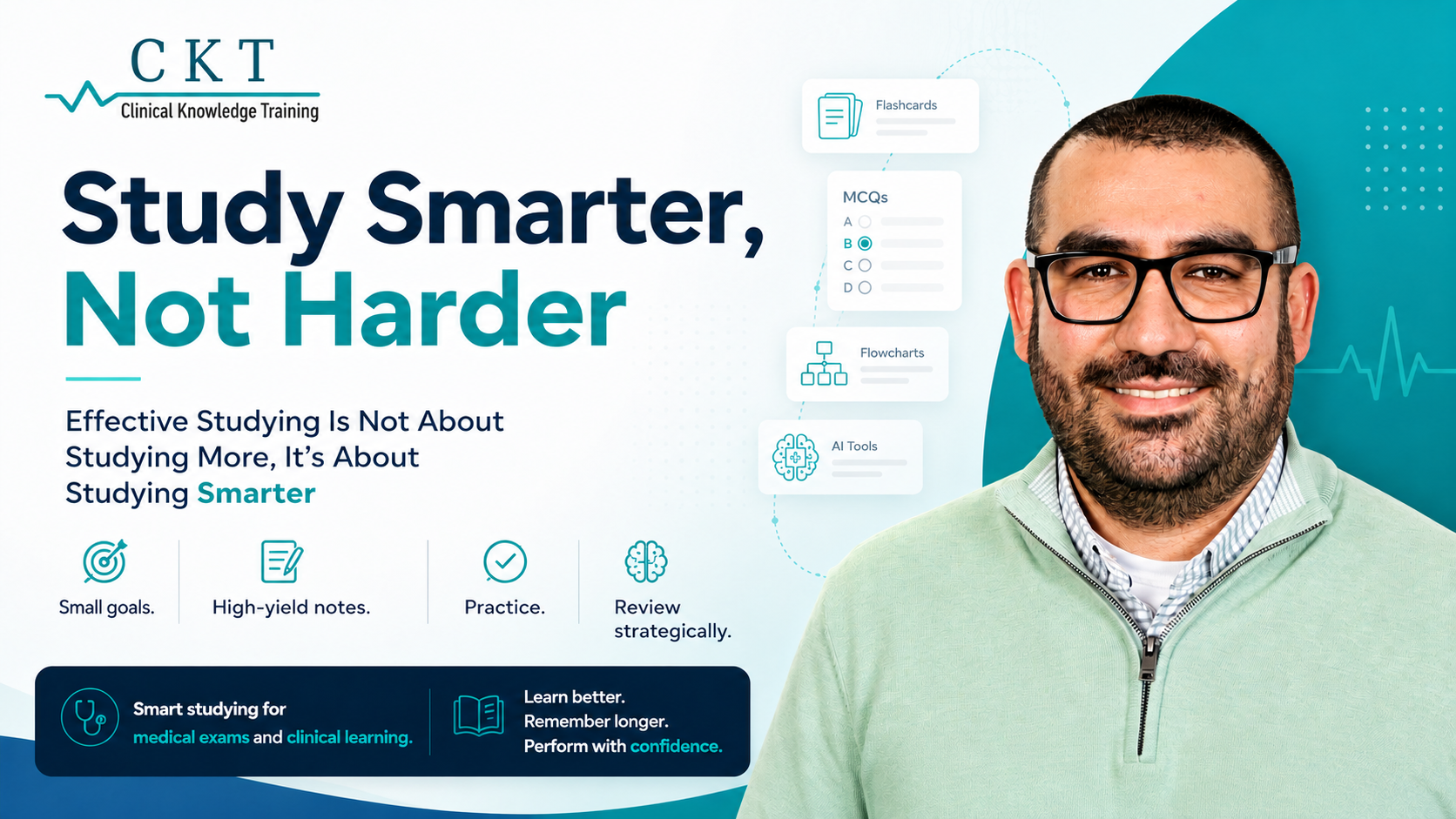
Effective Studying Is Not About Studying More, It's About Studying Smarter
Effective Studying Is Not About Studying More, It's About Studying Smarter.
After years of studying for medical school, postgraduate exams, and now teaching others, I've learned one important lesson:
The most effective study plan is not the one with the longest hours.
It is not about:
- Reading more books.
- Watching more videos.
- Writing more notes.
- Revising everything repeatedly.
It is about organizing knowledge in your mind so that it becomes simple, clear, and easy to retrieve when you need it, whether in clinical practice or during an exam.
My approach to smart studying
Instead of chasing hours, I chase small, achievable targets.
Each study session has one clear goal:
- One Pomodoro session.
- One topic.
- One learning outcome.
- A specific number of MCQs.
Small wins build consistency.
Don't write more notes, write better notes
I don't try to record every detail.
I focus on high-yield pearls that I can quickly review before an exam or recall during patient care.
For example:
Heart Failure Mortality-Reducing Drugs = ABCD
- A – ACEi/ARNI
- B – Beta-blocker (start only when euvolaemic)
- C – Mineralocorticoid receptor antagonist (spironolactone/eplerenone)
- D – SGLT2 inhibitor
Simple. Memorable. Clinically useful.
Teach to remember
One of the best revision methods is explaining concepts:
- To yourself.
- To colleagues.
- To students.
If you cannot explain it simply, you probably haven't understood it well enough.
Use AI as your study partner
Artificial intelligence has transformed the way I study.
I use it to:
- Organize complex information.
- Generate concise study pearls.
- Build algorithms and flowcharts.
- Create high-quality MCQs.
- Identify high-yield concepts.
- Convert long guidelines into practical notes.
- Simulate exam scenarios.
AI doesn't replace learning, it helps organize it.
Study like the exam
Knowledge alone doesn't pass exams.
Practice does.
I believe in:
- Solving as many high-quality question banks as possible.
- Aiming for 80% or higher before moving on.
- Timed mock exams.
- Timed role plays and OSCE stations.
- Checklist-based feedback.
- Reviewing mistakes more than correct answers.
Review strategically
Not every note deserves the same attention.
I highlight information according to importance:
 Must know
 High yield
 Nice to know
Then I revisit the important points using spaced repetition, reviewing them at increasing time intervals.
Create your own system
Don't copy someone else's notes.
Build your own algorithms, summaries, and memory aids.
The process of creating them is often more valuable than reading them.
My biggest lesson
The goal of studying is not to know more.
The goal is to think better, remember faster, and make safer clinical decisions.
Study to understand.
Study to apply.
Study to teach.
And most importantly…
Don't measure your progress by the number of hours you studied. Measure it by how confidently you can use what you've learned when it matters most